
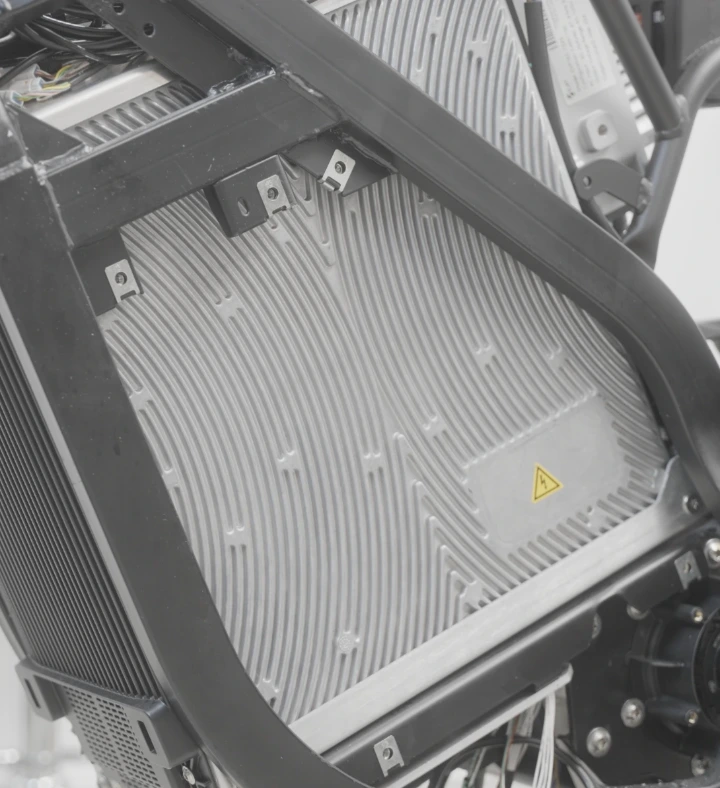
The battery at the center of electric motorcycles
At the heart of every electric motorcycle is its battery. While combustion motorcycles rely on fuel tanks and engines, electric motorcycles store energy in rechargeable battery systems that power an electric motor.
Understanding how electric motorcycle batteries work helps riders better understand range, charging, performance, and maintenance.
At DAB Motors, battery integration is a key part of the design of the DAB 1, where performance, weight, and usability must work together.
What an electric motorcycle battery does
An electric motorcycle battery stores electrical energy and delivers it to the motor through electronic control systems.
The battery powers:
acceleration
cruising speed
onboard electronics
control systems
Unlike gasoline, which is burned to produce motion, electricity is stored and released directly as energy for the motor.
Lithium-ion batteries in electric motorcycles
Most modern electric motorcycles use lithium-ion battery technology, the same chemistry used in electric cars and consumer electronics.
Lithium-ion batteries are widely used because they provide:
high energy density
long lifespan
relatively low weight
stable performance
rechargeability
Major battery cell manufacturers
Most electric motorcycle companies do not manufacture battery cells themselves. Instead, they source lithium-ion cells from specialized battery manufacturers.
Some of the world’s leading battery cell producers include:
Panasonic — https://www.panasonic.com/
LG Energy Solution — https://www.lgensol.com/
Samsung SDI — https://www.samsungsdi.com/
CATL — https://www.catl.com/
BYD — https://www.byd.com/
SK On — https://www.sk-on.com/
These companies produce the lithium-ion cells used across the electric mobility industry — from electric motorcycles and scooters to cars and energy storage systems.
Motorcycle manufacturers then design:
battery packs
cooling systems
battery management software
structural integration
This is where engineering and design choices differ between brands.
Battery management systems (BMS)
Electric motorcycle batteries are controlled by a Battery Management System (BMS).
The BMS monitors:
battery temperature
charging cycles
voltage levels
safety systems
energy distribution
This ensures battery longevity, reliability, and safe operation.
Electric motorcycles rely heavily on electronics and software, not just mechanical components.
Battery lifespan
Electric motorcycle batteries are designed to last for many years.
Battery lifespan depends on:
charging habits
temperature
usage patterns
battery chemistry
storage conditions
Modern lithium-ion batteries typically last thousands of charging cycles, which often translates into many years of riding.
Battery weight and motorcycle design
Battery size directly affects motorcycle weight and handling.
Some manufacturers prioritize maximum range through large battery packs, which increases weight.
Others focus on efficiency and lightweight engineering.
This design decision strongly influences the riding experience.
The DAB Motors approach to battery integration
At DAB Motors, battery technology is integrated into the motorcycle architecture rather than treated as a standalone component.
The DAB 1 balances:
battery capacity
motorcycle weight
electric performance
urban usability
design integration
Instead of maximizing battery size alone, the goal is to create a motorcycle that feels light, responsive, and natural to ride in everyday environments.
The future of electric motorcycle batteries
Battery technology continues to evolve through:
higher energy density
faster charging
improved thermal management
longer lifespan
reduced weight
As these technologies improve, electric motorcycles will continue to become more practical and efficient.
For DAB Motors, the DAB 1 represents how battery technology, lightweight engineering, and design can work together in modern motorcycling.